
If you’re filing taxes late in California, you’re not alone.
People fall behind for real reasons:
A divorce or breakup
A job change or unemployment
Moving to a new city or state
Starting a business (and not keeping records)
Depression, burnout, or life just hitting hard
Fear of owing money
A bad tax preparer who messed things up
The problem is, the IRS doesn’t care why it happened. They only care that it happened.
But here’s the good news: filing late is fixable. The key is doing it in the right order, with the right information, and without making panic moves that create bigger problems.
This guide explains what happens when you file taxes late in California, the penalties people don’t understand, and the cleanest way to fix it if you’re behind.
First: “Late” means two different things
This is where most people get confused.
You can be “late” in two ways:
You didn’t file your tax return
You filed your return, but didn’t pay the balance
These are not the same.
And the penalty difference is huge.
In most cases:
Not filing is worse than not paying
So even if you can’t pay, filing properly can reduce damage.
What happens when you file late in California?
Here’s what typically happens when a tax return is not filed on time.
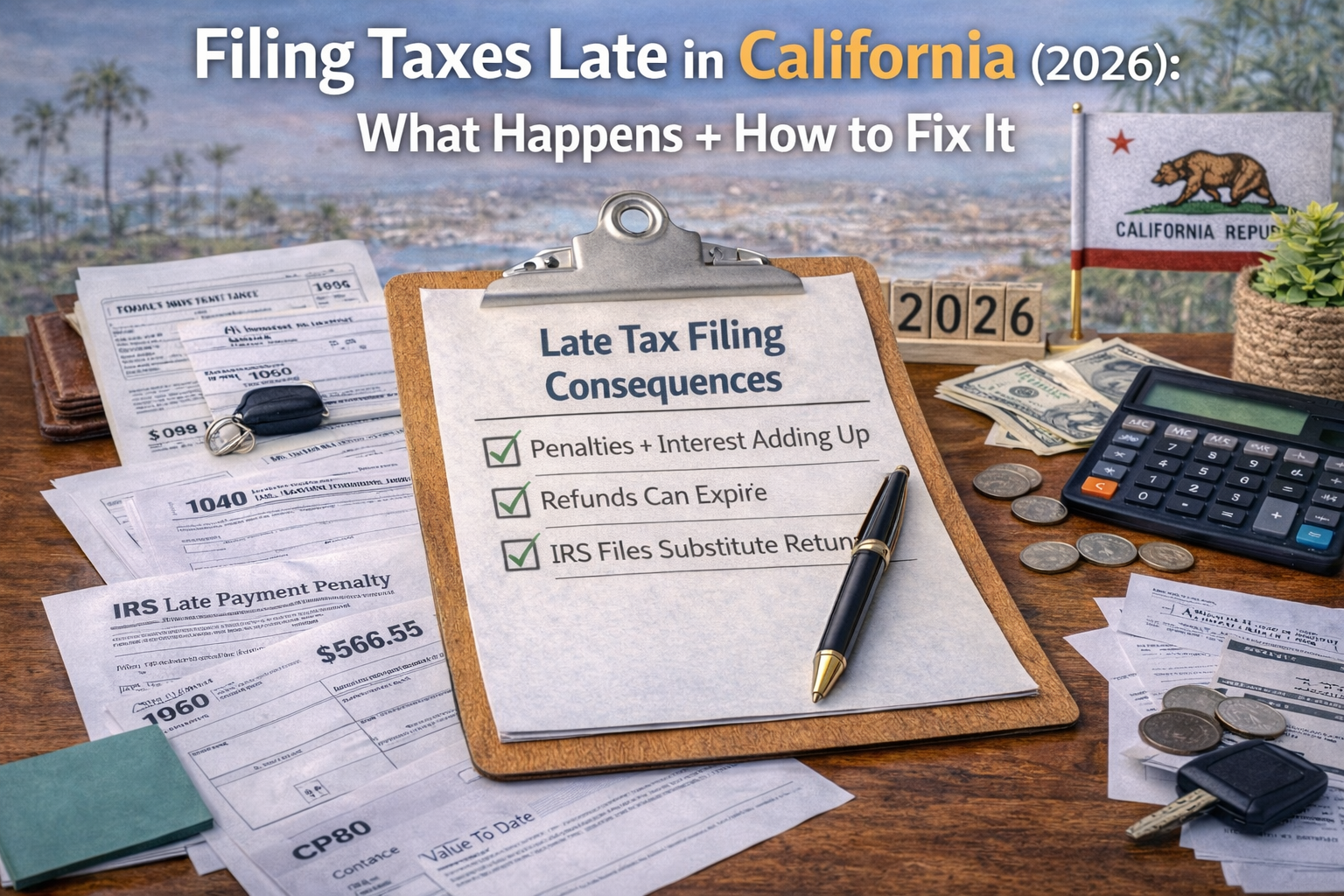
1) Penalties and interest start adding up
The IRS adds penalties and interest over time.
The longer you wait, the more expensive it becomes.
Even if your balance is not massive, penalties can build fast.
2) Your refund can expire
This one shocks people.
If you are owed a refund, the IRS generally gives you a limited window to claim it. Many taxpayers lose refunds because they waited too long to file.
We’ve seen hardworking people lose thousands just because they were late for too long.
3) The IRS may file a return for you (not in your favor)
The IRS can file what’s called a “substitute for return.”
This is not a real return that helps you.
It usually includes:
Income reported to the IRS
No deductions
No credits
No dependents
No business expenses
So if you’re behind, the IRS version of your taxes is usually the worst possible version.
4) The IRS can begin collections
If a balance is due and the IRS thinks you’re not compliant, enforcement can begin:
Notices in the mail
Tax liens
Levies
Wage garnishment
Bank account freezes
This doesn’t happen to everyone immediately, but it can happen, especially if multiple years are missing.
The two penalties people misunderstand
Let’s break these down in plain English.
Failure-to-file penalty (the big one)
This is the penalty for not filing your return at all.
This penalty is usually larger than the failure-to-pay penalty.
Failure-to-pay penalty
This applies when you file your return but don’t pay everything owed by the deadline.
This still adds up, but filing at least helps prevent the worst damage.
So if you’re behind and you’re scared of owing money, avoiding filing often makes the final bill worse.
Why people fall behind in California (and why it gets worse fast)
California is expensive. A lot of taxpayers survive on tight budgets even with decent income. One unexpected event can knock everything off course.
The moment you fall behind, fear starts making decisions:
People stop opening IRS letters
They avoid checking their mail
They ignore calls
They delay gathering documents
They hope it “goes away”
But the IRS doesn’t forget.
And when multiple years pile up, it feels impossible.
That’s why the goal isn’t just filing. The goal is building a clean path back into compliance.
How to fix late taxes in California (Step-by-step plan)
Here is the cleanest approach.
Step 1: Identify exactly which years are missing
Do not assume.
Do not guess.
A taxpayer may think they’re missing 2 years, and the IRS may show 4 years unfiled.
Also, some years may be filed but incorrect.
This is why professionals often review IRS transcripts first.
Step 2: Collect income documents for each year
You’ll want the real paperwork:
W-2 forms
1099-NEC, 1099-K, 1099-MISC
Brokerage statements
Mortgage interest documents
Business income records
If you don’t have them, you can request duplicates, and you can often reconstruct missing years using IRS wage and income transcripts.
Step 3: If you were self-employed, reconstruct expenses properly
This is where a lot of people get hurt.
Contractors and business owners often file late but don’t rebuild their expenses correctly. They end up paying taxes on income that wasn’t actually profit.
Good reconstruction includes:
Bank statements
Receipts
Invoices
Mileage logs
Business apps reports
Vendor payments
It doesn’t need to be perfect, but it must be reasonable and defensible.
Step 4: File missing years in the proper order
The order matters.
Filing year 2024 while 2021 and 2022 are missing often triggers processing issues.
Many times, the IRS wants older years filed first.
If multiple years are missing, file them in sequence unless your case strategy requires a different approach.
Step 5: Once filed, THEN resolve the balance
This is important.
A lot of taxpayers jump to:
Offer in Compromise
Payment plan
Penalty abatement
Fresh Start
But none of those matter if you’re not compliant.
In most cases, compliance comes first.
Once returns are filed, then you can:
Review total balances
Look at penalties/interest
Explore options to reduce or settle
Set up payments (if needed)
What if you owe money and you’re afraid to file?
This is the main reason people delay filing.
They think:
“If I don’t file, I don’t owe.”
That’s not how the IRS works.
The IRS can still assess tax and still enforce collections even if you don’t file.
If you owe and you’re behind, the best path is usually:
Get compliant
Confirm the balance
Reduce or manage it properly with a real strategy
In many situations, once you’re compliant, you may qualify for more options than you expect.
How long does it take to fix late taxes?
It depends on how many years are missing.
Typical timelines (realistic):
1 year missing: often manageable quickly
2–4 years missing: may take time depending on documents
5+ years missing: usually needs a structured plan
The biggest factor is not the IRS.
It’s how fast documents can be gathered and organized.
Orange County note: filing late can affect housing, business, and loans
In Orange County, late taxes affect more than refunds.
Unfiled returns can impact:
Mortgage approval
Refinancing
Business lending
SBA loans
Bonding
Real estate purchases
Certain professional licenses
So if you’re behind, fixing it is not just about avoiding the IRS. It’s about keeping your life moving forward.
Contact Information (ATR SoCal)
Advance Tax Relief – SoCal (ATR SoCal)
BBB Accredited
1122 E Lincoln Ave, Suite 201B
Orange, CA 92865
Phone: (714) 927-0038
Website: taxrelieforangecounty.com
We serve Orange County and surrounding cities including Irvine, Santa Ana, Anaheim, Newport Beach, Huntington Beach, Costa Mesa, Garden Grove, Fullerton, Orange, Tustin, and nearby areas.
FAQ: Filing Taxes Late in California (People Also Ask)
What happens if I file taxes late in California?
You may face IRS penalties and interest, and your refund could be delayed or expire. If you owe money, the IRS may begin collection activity.
Is it better to file late or not file at all?
Filing late is almost always better than not filing. The failure-to-file penalty is typically higher than the failure-to-pay penalty.
Can I file taxes late if I don’t have my W-2 or 1099?
Yes, but you should request duplicates first. If needed, income may be verified using IRS transcripts to avoid missing income issues.
How many years back can I file late taxes?
You can file late returns for many years. However, refunds may expire after a certain time, and missing years can trigger compliance enforcement.
Can the IRS garnish wages if I haven’t filed taxes?
Yes. If the IRS assesses a balance or files a substitute return, collections may occur, including wage garnishment and bank levies.

Leave a Reply