
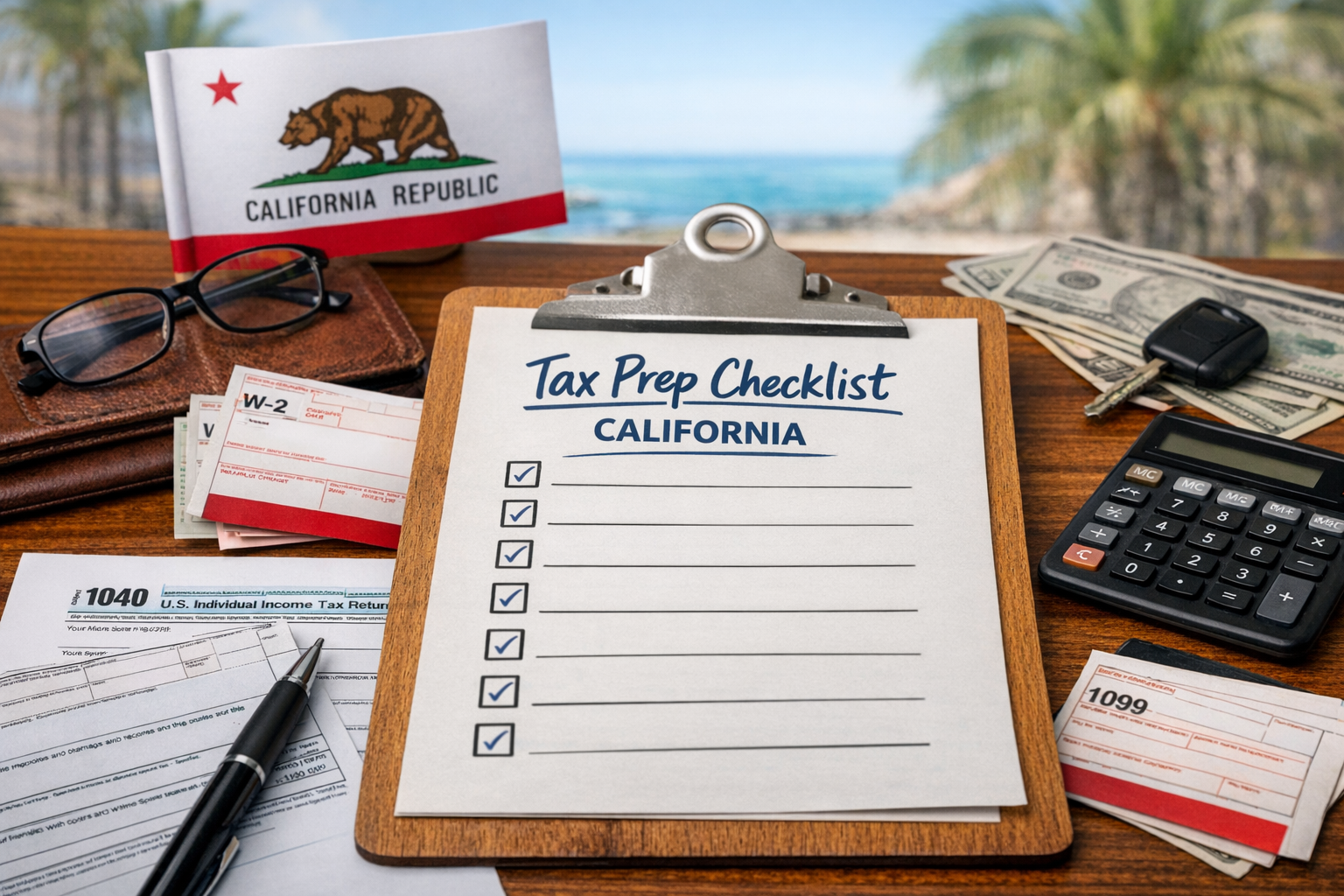
If you’re filing taxes in California, there are two kinds of people:
- People who file and never hear from the IRS again
- People who file… and then months later receive an IRS letter they weren’t expecting
Most IRS problems don’t start with fraud.
They start with simple mistakes — missing documents, wrong filing status, incorrect dependent claims, or self-employed deductions that were done incorrectly. And once the IRS catches it, it becomes a bigger issue than it needed to be.
In California (especially in areas like Orange County), tax returns are often more complex than the average filer realizes. Many taxpayers have multiple sources of income, investment accounts, real estate activity, 1099 contractor work, or family tax credits — and those details are exactly where filing mistakes happen.
This article is a practical tax prep checklist you can follow before you file, so you can avoid costly errors and keep your return clean.
The first rule before filing: don’t file until your paperwork is complete
Before we get into mistakes, this one step will eliminate most IRS problems:
Make sure you have all income documents before filing.
The IRS already has much of your information through:
Employers (W-2s)
Contractors and platforms (1099s)
Banks (interest income)
Brokerages (stocks, dividends)
Mortgage companies (Form 1098)
Certain payment processors (1099-K reports)
When your return doesn’t match what they received, the IRS will eventually send a notice. Sometimes it’s a small adjustment. Other times it’s a big tax bill with penalties and interest attached.
Now here are the 7 filing mistakes we see most often — including from intelligent, honest taxpayers.
Mistake #1: Filing with missing income (W-2s, 1099s, side work)
This is the most common reason taxpayers receive a CP2000 letter.
People think:
“If I didn’t get the form, it doesn’t count.”
That’s not how it works.
Even if you never received your 1099, the IRS may have it. The same goes for W-2s that were sent to an old address, or contractor income reported through payment platforms.
Before filing, make sure you have:
All W-2s from every job
All 1099 forms (1099-NEC, 1099-MISC, 1099-K)
Payout summaries from Stripe, Square, PayPal, Venmo, etc.
Gig income summaries (Uber/Lyft/DoorDash/Instacart)
Bank deposits/invoice records for business income
California reality: many people have a “regular job” and side income on top of it. The IRS doesn’t separate the two — it all counts.
Mistake #2: Choosing the wrong filing status
This mistake isn’t just a technical issue — it affects your tax bill, credits, and audit risk.
The most common filing status problems include:
Single vs Head of Household
Married Filing Jointly vs Married Filing Separately
Claiming Head of Household without meeting requirements
If you are a single parent in Orange County (or anywhere in California), Head of Household can be valuable — but you must qualify.
To qualify for Head of Household in most situations, you generally must:
Be unmarried (or considered unmarried) at the end of the year
Pay more than half the cost of keeping up the home
Have a qualifying child/dependent living with you more than half the year
If your custody schedule is complicated or you’re recently divorced, this is an area you don’t want to guess on.
Mistake #3: Claiming dependents incorrectly (this triggers IRS letters fast)
Dependents are one of the biggest reasons refunds get delayed.
Common errors include:
Two parents claiming the same child
Claiming a dependent who didn’t live with you long enough
Incorrect Social Security numbers
Mixing up who qualifies for what credit
If you’re co-parenting, the IRS will not accept “we agreed verbally.” They want the rules followed, and the return has to be filed correctly.
Before filing, confirm:
Dependent names are spelled correctly
Social Security numbers match the cards
Months lived with you are accurate
Childcare expenses are documented properly
If the IRS rejects the dependent claim, you may lose credits and may have to pay back part of the refund.
Mistake #4: Forgetting credits you qualify for (or taking credits you don’t qualify for)
This mistake can hurt you in two different ways:
Some people miss credits and pay more than they should
Others claim credits incorrectly and get IRS notices later
Common credits include:
Child Tax Credit
Additional Child Tax Credit
Earned Income Tax Credit (EITC)
Child and Dependent Care Credit
Education credits (AOTC/Lifetime Learning)
The key is that credits have qualification rules. If your income changes, family changes, or filing status changes, your eligibility can change.
In California, we also see families filing without properly listing:
Childcare provider EIN/SSN
Education documents (1098-T)
Proper dependent relationship and residency
Mistake #5: Bad Schedule C deductions (especially contractors and business owners)
If you have 1099 income, Schedule C deductions must be legitimate and documented.
This is where a lot of people get into trouble because they:
Overwrite expenses
Mix personal and business spending
Write off everything without proof
Claim “home office” incorrectly
Claim vehicle expenses incorrectly
A clean Schedule C return includes:
Accurate business income
Reasonable deductions
Documentation (receipts, bank records, mileage logs)
Before filing, gather:
Mileage logs
Phone/internet bills (business use portion)
Business equipment receipts
Software subscriptions
Marketing expenses
Business insurance
Merchant processing fees
Office supplies
Contract labor payments
Bank statements showing business expenses
The IRS does not care how “nice” your story is if you can’t prove the deductions. Documentation is what protects you.
Mistake #6: Filing late without a plan (and paying penalties unnecessarily)
When people fall behind, they often do one of two things:
They avoid filing completely
They file fast without preparation just to “get it over with”
Both are dangerous.
If you’re behind on filing, you need a strategy — especially if you think you may owe.
Here’s what matters:
Failure-to-file penalties are usually worse than failure-to-pay penalties
The IRS may file a return for you (not favorable)
Missing years may affect payment plan or settlement options
Filing in the wrong order can create confusion and notices
If you haven’t filed in years, the best first step is usually to gather records and confirm IRS data through transcripts, then file correctly.
Mistake #7: Not reviewing IRS transcripts (the smartest taxpayers do this)
This is the biggest “pro” move most people ignore.
Before filing, transcripts can confirm what the IRS already has reported under your Social Security number.
Transcripts help:
Confirm W-2s and 1099s
Prevent missing income issues
Identify old balances and penalties
Confirm which years are unfiled
Reduce IRS mismatch letters later
Transcript review matters even more if:
You had multiple jobs
You have contractor income
You had investment activity
You received IRS letters in the past
You’re behind on filing
A lot of IRS problems can be avoided just by verifying income and history before filing.
A simple California tax prep checklist you can follow before you file
If you want a clean, stress-free filing, here’s the practical checklist:
Personal information:
ID for taxpayer and spouse
Social Security cards/ITINs
Last year tax return
Bank info for direct deposit
Income:
All W-2s
All 1099s
Gig income summaries
Brokerage/crypto tax forms
Interest/dividends
Family & dependents:
Dependent SSNs
Months lived with you
Childcare provider info + totals paid
Education records (1098-T)
Home/real estate:
Mortgage interest (1098)
Property taxes
Home sale closing statements (if sold)
Rental property income/expenses
Business/self-employed:
Mileage logs
Business bank statements
Expense receipts
P&L statement (if available)
Contact Information (ATR SoCal)
Advance Tax Relief – SoCal (ATR SoCal)
BBB Accredited
1122 E Lincoln Ave, Suite 201B
Orange, CA 92865
Phone: (714) 927-0038
Website: taxrelieforangecounty.com
We serve Orange County and surrounding cities including Irvine, Santa Ana, Anaheim, Newport Beach, Huntington Beach, Costa Mesa, Garden Grove, Fullerton, Orange, Tustin, and nearby areas.
FAQ: California Tax Prep Checklist (People Also Ask)
What documents do I need to file taxes in California?
Most taxpayers need ID, Social Security info, W-2 and 1099 income forms, investment documents (1099-B/DIV/INT), and documentation for credits and deductions.
What happens if I forget to report 1099 income?
The IRS may send a CP2000 notice and increase your tax due, plus penalties and interest.
Is it better to file married jointly or separately in California?
It depends on your income, deductions, and household situation. Some couples benefit from joint filing, while others may benefit from separate filing, especially with certain liabilities.
How can I avoid IRS tax filing mistakes?
Don’t guess. Gather documents first, confirm income sources, and consider reviewing IRS transcripts, especially if you have multiple income sources.
Do I need receipts for business deductions?
Yes. Receipts, bank statements, invoices, and mileage logs help prove deductions and protect you if the IRS questions your return.
Should I file taxes if I can’t pay?
Yes. Filing is required even if you can’t pay right away. Not filing often results in larger penalties.
Leave a Reply